
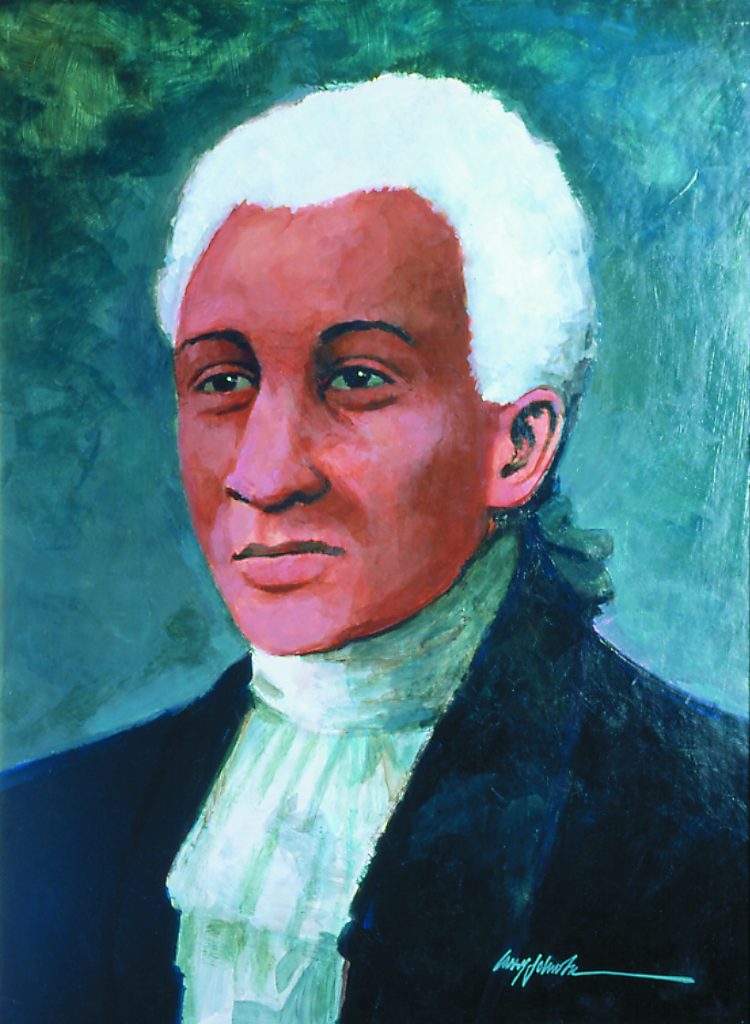
Prince Hall Masons
Prince Hall Freemasonry is the oldest African American Masonic organization. It aimed to foster racial uplift, mutual aid, and social justice.
Prince Hall was an artisan and abolitionist in Boston. Hall’s birthplace and birth date are not precisely known, but he is believed to have been born in 1735. A successful leather merchant, Hall owned property in Boston and was therefore on the city’s voting roll. He was an engaged citizen, advocating for the Black community as a vocal supporter of the abolition of slavery. Hall died in 1807 and is buried in Boston’s historic Copp’s Hill Cemetery.
In 1775, after Hall and other free Blacks tried unsuccessfully to join the city’s all-white Masonic lodge, they were initiated into Lodge 441, which was attached to a British army regiment. When the British retreated from Boston in 1776, Hall’s group received a permit to assemble as African Lodge No. 1. In 1784, the Grand Lodge of England officially chartered the group as African Lodge No. 459. More than 4,500 lodges worldwide are descended from this original organization, now known as the Worshipful Prince Hall Grand Lodge of Massachusetts.
Founded in 1784, Prince Hall Freemasonry is the oldest African American Masonic order. While Prince Hall Masons practiced the secret rituals and moral teachings of Freemasons worldwide, they also shared with other Black fraternal organizations a commitment to racial uplift, mutual aid, and social justice. During slavery and segregation, Masonic lodges provided safe gathering places for the black community. Membership included various community leaders—prominent businessmen, clergymen, and politicians—who also served as role models for Black male identity and empowerment. Membership also provided essential networks for artisans and business owners, and even granted protection. For instance, in 1829, when a protest by white Cincinnati workers against Black employment erupted in violence, Prince Hall Masons organized patrols for the community.
Who We Are
The Prince Hall Masons are the oldest and largest group of Masons of African origin in the world. Today there are forty Grand Lodges of Prince Hall Freemasonry in the United States, Canada, the Bahamas, and Liberia. These Grand Lodges preside over more than 5,000 lodges. All of them claim descent from the Prince Hall Grand Lodge of Massachusetts which is traced back to the African Lodge No. 459.
What We Do
Throughout the State of Washington and Jurisdiction, which includes Canada, England, Germany, Iceland, Iraq, Kuwait, Turkey, Guam, Republic of Korea, Okinawa and Mainland Japan and the Republic of Philippines, our supreme goal is to render service that will improve the social, cultural and economic conditions of our fellow man.
Lastly, our measure of giving is an act of unselfish sacrifice for the benefit of others.”
The exact origin of the square and compasses symbol (or more accurately, a square and set of compasses joined together) is unknown. The symbol’s origin is theorized to have come from the stonemasons’ guilds during the middle ages. In fact, most language and symbolism used in our fraternity comes from this era.
Seen on numerous structures around the world, the square and compasses symbol with a G in the middle instantly marks a building as a Masonic entity. The start of this Freemasonry logo dates as far back as the 1780s, but its earliest known appearance, without any Masonic context, can be found in a book that was printed in the early sixteenth century. However, most Masonic scholars do not consider this relic to have any connection to Freemasonry.
The compass in the square and compasses came from the idea of “keeping within compass” which is from an old rhyme: “By honest and industrious means, we live a life of ease, then let the Compass be your guide and go where’er you please.” In the 1700s, this phrase and ideology was widely known, and there were many objects such as teapots, plates, and engravings that adopted this symbology as decoration without any connection to Freemasonry. “Keeping within compass” meant that you were on the right path and behaving in the proper fashion. The fraternity soon after adopted this theme, and it has become the basis for the standardization of Masonic values today.
Meaning of the Square and Compasses
The entire square and compasses as a whole is said to have a number of different meanings, representing a combined sense of judgement, balance, and stability. Derived from the working tools of Stonemasons, the symbol shows an architect’s tool and is meant to serve as a metaphor for how the teachings of Freemasonry help to “build” members into better men.
The Letter “G”
The infamous letter “G” most often found in the center of the Masonic compass holds a multitude of meanings. To start, it represents geometry, a mathematical concept critical to the work of Stonemasons from which modern Freemasonry derives. Geometry is known to uncover the relationship of objectsand the wonders of nature, which aligns with the principles of the craft. Throughout the degrees of Freemasonry and the Scottish Rite, the tools of Stonemasons and the principles of geometry are used to inform the lessons the craft bestows upon members.